Odyssey 9
The time has come for Odysseus himself to sing his own epic odyssey, and the hero chooses to start with the most celebrated story of the Homeric Odyssey, about the blinding of the Cyclops.
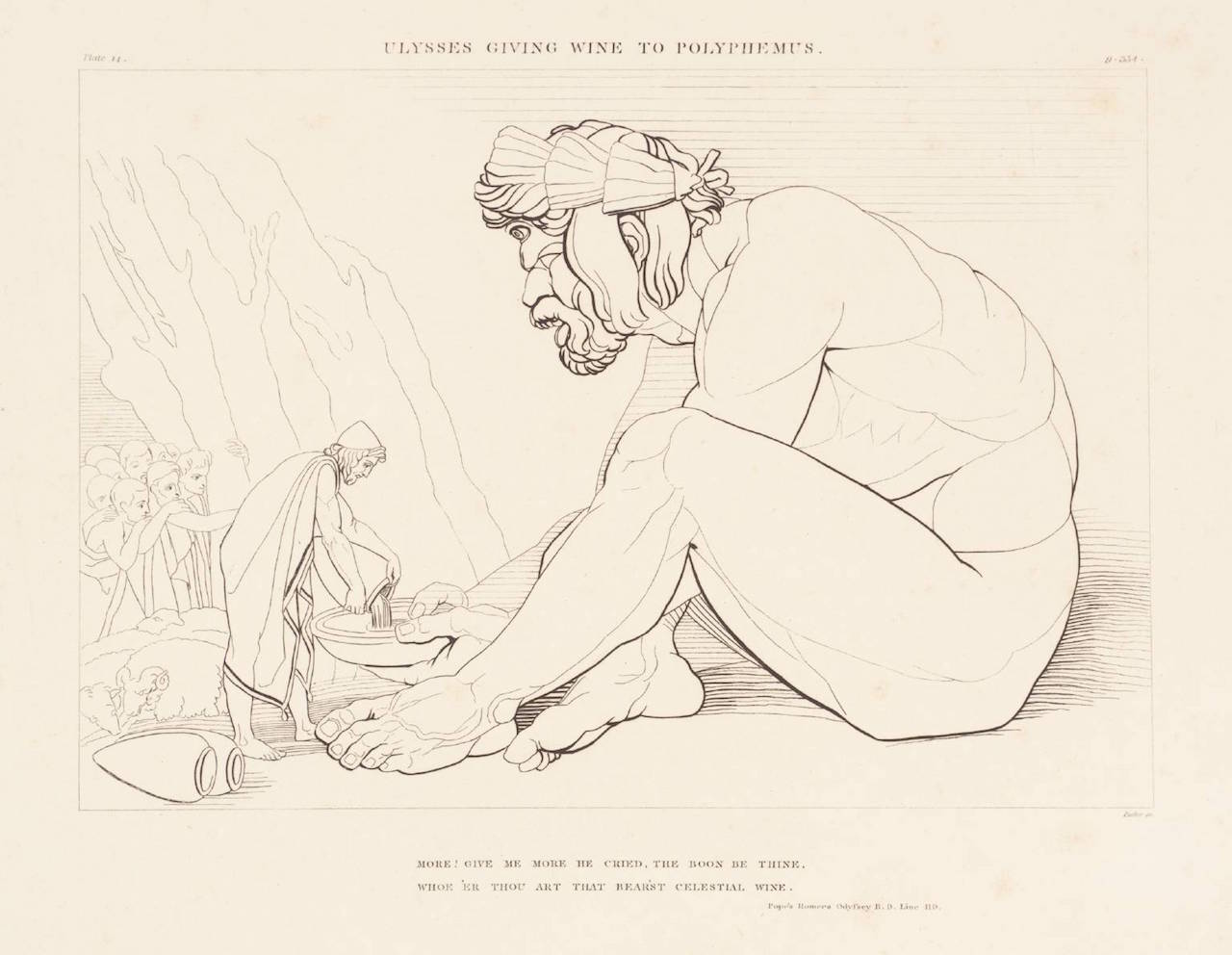
“Ulysses Giving Wine to Polyphemus” (1805). John Flaxman (1755–1826). Purchased as part of the Oppé Collection with assistance from the National Lottery through the Heritage Lottery Fund, 1996. Image via the Tate.
The transition from Rhapsody 8 to Rhapsody 9 marks a change in the form of singing for the singer of tales. The poetic bravura of Demodokos, blind singer of the Phaeacians, will now be superseded by a masterpiece of epic narration performed by Odysseus himself, who is starting to sing his own epic odyssey. The hero’s song will extend from the beginning of Rhapsody 9 here all the way through the end of Rhapsody 12, and the size of this song, consisting of four rhapsodies, will correspond to one-twelfth of the Homeric Iliad and Odyssey combined. Odysseus will perform his song in the style of the Homēridai, notional descendants of Homer who performed the Iliad and Odyssey in relay. The relay performance, which was competitive as well as collaborative, consisted of twelve units, each unit consisting of four rhapsodies, and it took place at the seasonally recurring festival of the Panionia at a place called the Panionion in Asia Minor. As already noted before, this festival was the political and cultural self-expression of the Ionian Dodecapolis, a confederation of twelve states that reached its apogee in the eastern Greek world during the late eighth and early seventh century BCE. (On the Ionian Dodecapolis, see the anchor comment on I.01.463; also the comment on O.07.321; also on I.02.867–869 and on I.20.403–405; see also under Ionian Dodecapolis in the inventory of Words and Ideas.) The division of the Iliad and Odyssey into twelve units, six for the Iliad and six for the Odyssey, with each unit containing four rhapsodies, corresponds to the division of the Ionian confederation into twelve states. It may be argued, then, that each one of the twelve states of the Ionian Dodecapolis fielded a rhapsode for performing competitively one of the twelve epic units. Which rhapsode was assigned which one of the twelve epic units could have been determined by lottery or perhaps by way of seasonal rotation. It may also be argued that the rhapsodic unit extending from the start of Rhapsody 9 here all the way through the end of Rhapsody 12 represents an idealized rhapsodic performance in the style of the Homēridai. And Rhapsody 9 begins with a kind of Homeric signature at O.09.03–011—the mark of Homer, as it were.